
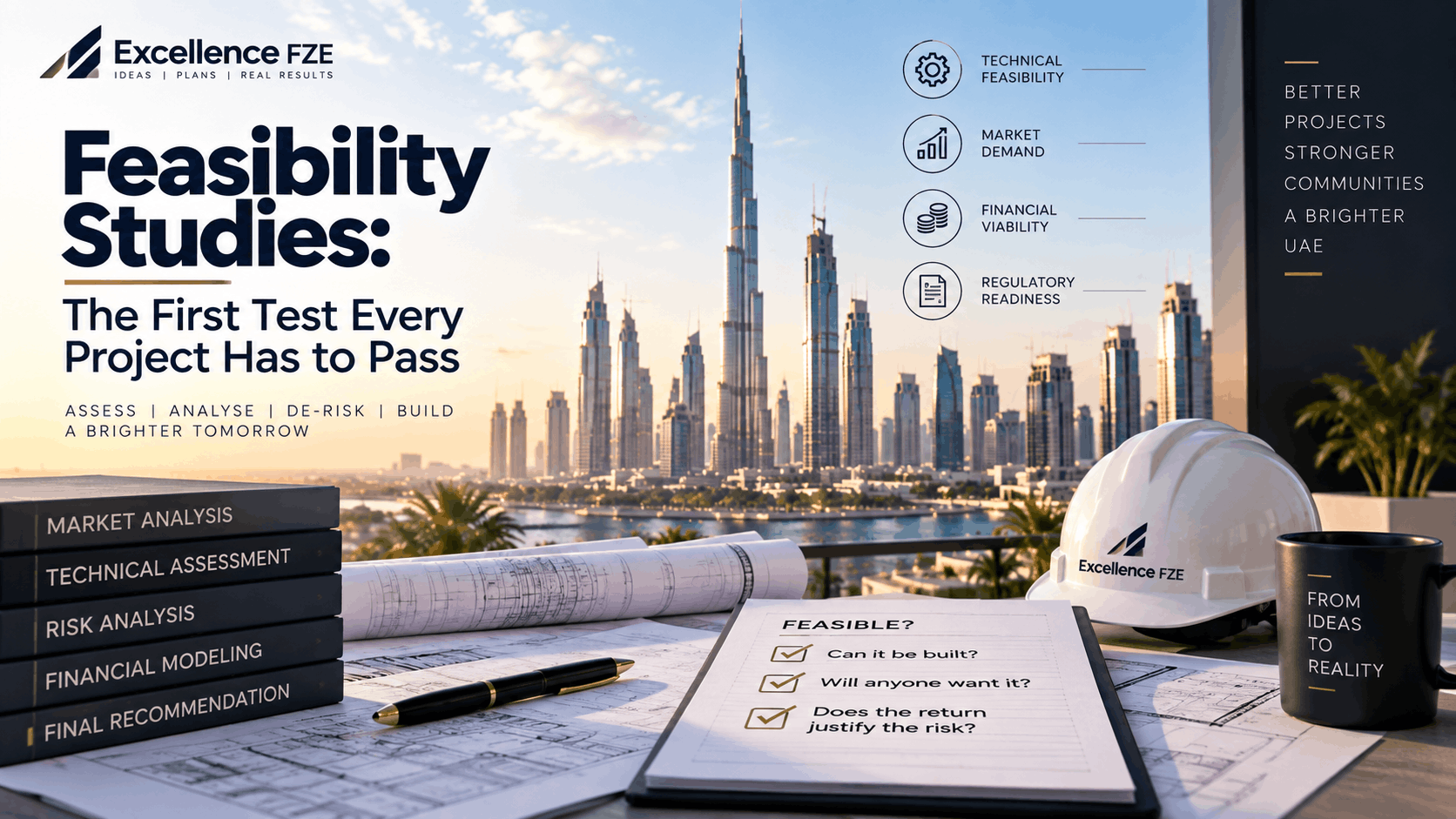
Every project starts the same way – with a conviction that it should exist. A site looks right, a market gap looks obvious, a return looks achievable. That conviction is necessary, but it isn’t evidence. A feasibility study is where conviction either earns its place or gets corrected, before it turns into a signed contract.
At Excellence FZE, we treat the feasibility stage as the single highest-leverage point in a project’s life. Get it right, and every decision that follows – financing, design, delivery – sits on solid ground. Get it wrong, and no amount of good execution later can fully undo it.
What a feasibility study is actually for
A feasibility study is often misunderstood as a formality: a document produced to satisfy a lender or an internal committee. Done properly, it’s the opposite of a formality – it’s a structured argument for or against a specific course of action, built on numbers that can survive scrutiny.
There are three questions a serious feasibility study has to answer honestly:
Can it be built? This covers the technical and regulatory reality – land use, zoning, infrastructure capacity, licensing pathways, and the practical constraints of the site or sector. A project that is financially attractive but technically or legally obstructed isn’t feasible; it’s a plan waiting for a rewrite.
Will anyone want it? Market demand has to be tested against real comparables, not aspiration. This means understanding who the end user or buyer actually is, what alternatives they have, and what price or rent level the market will genuinely bear – not the level the model needs it to bear.
Does the return justify the risk? This is where most of the difficult conversations happen. A feasible project isn’t simply one that shows a positive return in a base-case scenario; it’s one that still makes sense when a few assumptions move against you.
Where feasibility studies go wrong
In our experience advising developers and organisations across the UAE, the same handful of mistakes appear again and again.
Optimistic base cases with no stress testing. A single scenario, run once, with the best available assumptions, tells you almost nothing about how exposed the project actually is. The real question isn’t “what does this look like if things go to plan,” it’s “what does this look like if the sales cycle takes twice as long, or construction costs rise 15%.”
Market data that confirms the thesis instead of testing it. It’s easy, consciously or not, to select comparables and demand assumptions that support the outcome you already want. A useful feasibility study is adversarial toward its own conclusions.
Regulatory and licensing steps treated as a footnote. In the UAE specifically, the path to approval – free zone or mainland, the specific licensing authority, land use classification, utility connections – can materially change both the timeline and the cost base. Studies that leave this until later routinely underestimate both.
Sunk cost creeping into the analysis. Once money and time have already gone into a concept, there is quiet pressure for the feasibility study to validate it rather than test it. The most valuable studies are the ones commissioned before anyone is emotionally or financially committed to a particular answer.
What a rigorous study actually contains
A feasibility study worth acting on typically covers:
– A site and technical assessment, including land status, zoning, and physical constraints
– A regulatory and licensing pathway, mapped against realistic timelines
– Market and demand analysis grounded in comparable transactions, not projections alone
– A financial model with sensitivity analysis across the variables most likely to move
– A clear-eyed risk register, ranked by likelihood and impact, with mitigation options attached to each item
– A recommendation – proceed, proceed with modification, or do not proceed – stated plainly, not buried in caveats
That last point matters more than it might seem. A feasibility study that hedges every conclusion so thoroughly that no decision can be made from it has failed at its one job.
Why this is worth getting outside help for
Internal teams are often the wrong people to run a feasibility study on their own project – not because they lack the skills, but because they lack the distance. They know too much about why the project should work and not enough incentive to argue convincingly for why it might not.
This is where an independent consultancy earns its fee. Our role isn’t to make a project look viable; it’s to tell a client exactly what has to be true for it to stay viable, and to be equally comfortable delivering a “yes,” a “yes, if,” or a “not yet.”
If you’re standing at the start of a project and want that answer before you’re financially committed to a particular one, that’s precisely the conversation to have with us early.
Excellence FZE is a Dubai-based project development and management consultancy. To discuss a feasibility study for your next project, get in touch with our team.